

Most markets treat retention as a problem to manage, but Japan treats it as a standard to meet. According to the Sensor Tower Japan App Trends 2024 report,

Why Japan Changes the Meaning of an Install

Japan's e-commerce LTV reaches $9.67 by the end of month one, which is more than double the U.S. benchmark. That gap is not the result of a unique culture or a favorable market, but of how the best apps in Japan are designed from the very first session onward.
The principles behind that performance are not exclusive to Japan. Any growth team, anywhere, can apply them. In this article, we look at exactly how rewarded UA and smart CRM (Customer Relationship Management) work together to build lasting user value, drawing on expert insights from one of Japan's leading mobile CRM platforms.
Japanese users do not behave like passive traffic. They are more selective and demanding about whether an app is actually worth their time. That changes the entire picture for any team trying to grow in this market, because the rules of acquisition that work elsewhere do not automatically transfer here.

Ryutaro Nakano, Evangelist at Repro Inc., explains:
That one difference reshapes everything that follows. Because the install is a conscious choice rather than an impulsive tap, the user arrives with a clear picture of what they expect. When the app does not match that picture in the first session, the disappointment is immediate and the exit is fast.
This is why success in Japan depends less on driving traffic and more on earning users’s choice. When early drop-off is high, there is always one reason: the message before the install and the experience after it do not feel like the same story. That gap between promise and experience shows up faster than most teams expect.


That is the real challenge inside rewarded UA. A user may install through a fair value exchange and still leave if the days that follow feel empty, because getting someone through the door is only half the job. The other half is giving them a reason to come back before their interest fades, and in Japan, that window is shorter than almost anywhere else.
Which brings us to the moment most rewarded campaigns get wrong.
The First 3 to 7 Days Decide the Relationship
In most markets, the first week after install is treated as a warm-up phase where users find their footing. Japan works differently. The first week is less of a warm-up and more of a test, with users deciding whether the app deserves a permanent place in their daily routine. Apps that are slow to deliver something genuinely useful do not earn a second chance.


The Handoff from Reward to Retention
Rewarded UA creates a clear exchange: the user opts in, completes an early goal, and receives something of value in return. That structure is one of the format's greatest strengths, but it also creates a fragile moment, because once the reward is collected and the first goal is done, many users have not yet decided what to do next.
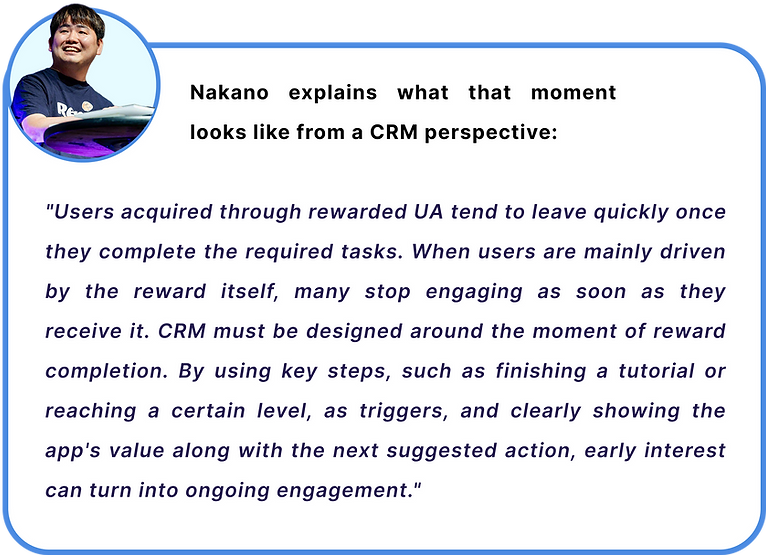
That window right after the reward is collected is one of the most important moments in the journey. The user has finished their first goal but has not yet formed a habit, so what the app does next will either create a new reason to stay or let the momentum disappear.

The takeaway is simple but easy to miss: the moment after reward collection is not the end of the journey. It is the point where the app gets one chance to replace the incentive with something more lasting.
Knowing whether the handoff is working requires measuring the right things, and most teams are looking at the wrong numbers.


How to Know If Your Strategy Is Actually Working
Most teams measure long-term value by looking at revenue over many months, which is the right goal but far too slow for day-to-day decisions. By the time the numbers tell a clear story, it is already too late to fix what went wrong in the first week. The smarter approach is to identify which early behaviors predict long-term value and track those from day one.

Beyond retention rates, three more signals deserve close attention. Session depth, meaning how far users go within a single visit, correlates strongly with long-term value. The completion rate of key actions, such as finishing setup or making a first purchase, directly predicts whether users will return. And the push notification opt-in rate is easy to overlook early but limits CRM effectiveness downstream. Finally, tracking revenue by traffic source at day 14 identifies which channels bring users who actually spend, not just users who install.
Once users are retained, the next challenge is staying in touch without pushing them away.
Spam Is a Context Problem, Not a Frequency Problem
Most teams that struggle with push notifications assume they are sending too many, so they reduce the number of messages and wait to see if things improve. Often they do not, because the real problem was never about how often messages were sent; it was about whether those messages felt relevant to what the user was actually doing at the time.

A push message does not feel intrusive simply because it arrives, but it feels when it has nothing to do with what the user just did, what they care about, or what they need next. When the message reflects their recent behavior, it stops feeling like an interruption and starts feeling like a useful nudge.
Nakano also draws a clear line between two types of messages: push notifications exist to bring users back when they have been away, while in-app messages exist to support what users are already doing. When those roles get mixed up, even helpful content starts to feel like noise.
Context does not just matter inside CRM. It matters in how UA and CRM talk to each other.

Where UA and CRM Need Each Other Most
Many teams still treat UA and CRM as two separate jobs. One side brings users in; the other tries to keep them. But when those two sides do not share information about why a user installed or what they responded to, the messages users eventually receive feel disconnected from what attracted them in the first place.
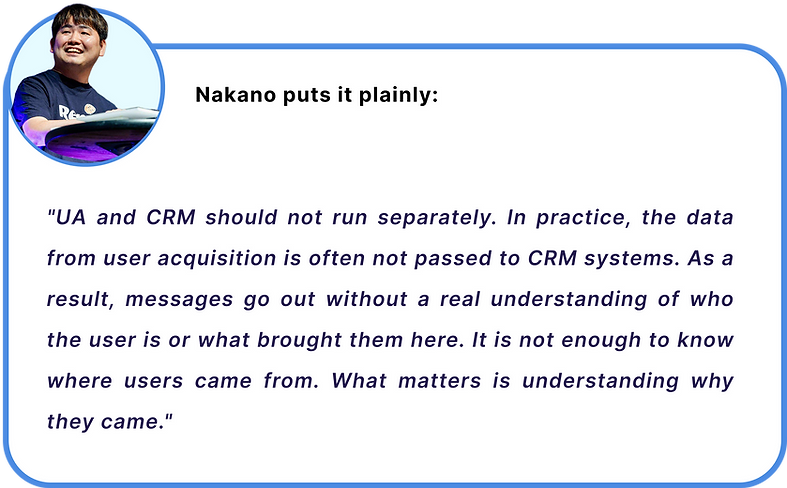
For Repro, three early signals matter most: what kind of content pulled the user in before they installed, which ad they responded to because different messages create different expectations, and what the user does in their first session, since early behavior often predicts future value more reliably than the acquisition channel itself.
When that information flows from UA into CRM, the experience becomes more connected. Messages feel relevant, users feel understood, and the same volume of traffic produces better results.

This is where rewarded UA platforms can play a direct role in closing that gap.

Rewarded UA and the First Value Moment
Rewarded UA works best when it helps users reach their first win quickly, before the initial motivation fades. That is why the structure of the journey matters just as much as the reward itself: a well-designed sequence uses each step to build a reason to continue, not just to deliver the incentive.
A well-structured rewarded journey for any app might look like this:

Each step removes one reason to drop off, making the next move feel obvious and personally relevant rather than leaving users to figure out on their own why they should stay.


Design for Continuity, Not Just Acquisition
Japan earns its retention numbers because the best apps there are built with continuity in mind from the very first session. The install is not the win, but the moment the user begins deciding whether the app deserves a permanent place in their life, and in Japan that judgment is made faster and more strictly than almost anywhere else.
The lesson for growth teams everywhere is that rewarded UA and smart CRM are not two separate jobs that happen to share the same users. They are two halves of the same system, and long-term value only grows when they are designed together rather than handed off in isolation.
The most practical place to start is by changing what you measure. Tracking how each group of new users behaves and spends by day 14, broken down by traffic source, shifts the definition of a high-quality user. When that definition changes, everything else follows: which channels deserve more budget, how onboarding is designed, and what CRM should say first.
That is exactly what makes Japan worth studying. The teams that have figured out continuity there have not just solved a local problem – they have figured out something that works everywhere.
