
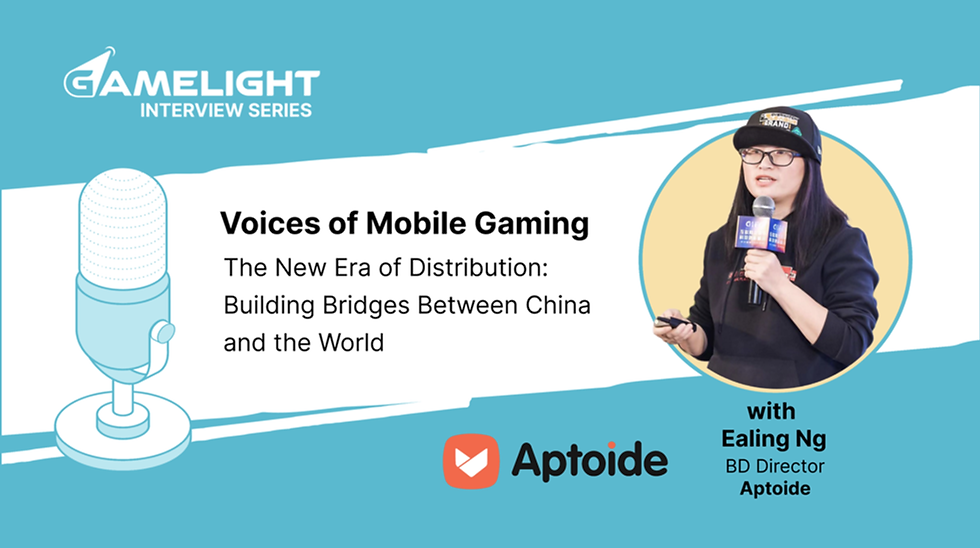
Welcome to a new edition of Voices of Mobile Gaming!
Today, we’re speaking with Ealing Ng, Director of Business Development at Aptoide and former Overseas Operations Director at NetEase Games - one of the industry’s most influential cross-border leaders. With 17 years of experience across both top Chinese companies and global tech ecosystems, she has helped countless studios navigate the complex realities of entering China, scaling internationally, and building long-term partnerships that actually work.

Known as a bridge-builder between East and West, Ealing has cultivated a powerful network of over 10,000 industry leaders in China and has become a trusted advisor for developers seeking to break through cultural, operational, and strategic barriers. From alternative app store distribution to high-level negotiations with Chinese publishers, her perspective offers a rare insider view into the fast-changing global landscape.
Hi Ealing,
It’s truly great to have you with us! You’ve spent years helping companies understand both sides of the global market. Let’s begin by exploring the current dynamics between China and the rest of the gaming world - and what developers should really pay attention to in 2026.


1. How has the “China opportunity” changed in the past few years? Is it still what Western developers imagine it to be?

2. How has the distribution landscape evolved over the past two years, and what do developers still underestimate about alternative app stores?
Many Western developers remember China as a “land of gold.” The opportunity is still real — but its nature has fundamentally changed.
China today is not a market that rewards quick arbitrage or simple distribution plays. It has evolved into a strategic, innovation-driven ecosystem. Chinese players are more discerning and experienced than ever. They expect distinctive emotional engagement and innovative core loops, not superficial localization. Platforms such as WeChat and TikTok have made mini-games mainstream, unlocking user bases that never interact with traditional game app stores. Innovation now shapes global trends, from hybrid gameplay templates to monetization design. Lastly, monetization logic has shifted from short-term user acquisition to long-term ecosystem building, where durable live ops and content strategies outperform fast-money tactics.
In short, China remains one of the most challenging and rewarding markets in the world - but only for developers willing to rethink assumptions and commit for the long term.


Recent regulatory trends, including the EU’s Digital Markets Act, are reducing the dominance of Google Play and the App Store and accelerating the growth of alternative app stores.
Aptoide, for example, connects developers with over 500 million active users across Europe and the Americas, with high-paying engagement and profitable revenue shares. Many developers still underestimate that alternative stores are not secondary options — they are strategic channels for diversification, efficient monetization, and sustainable growth. In markets where UA is expensive, alternative stores can deliver high net revenue with minimal acquisition cost, enabling games to grow profitably without overreliance on a single platform.


3. How does Chinese decision-making logic differ from Western teams when negotiating partnerships?
In China, partnerships are viewed as long-term relationships, not fixed-scope projects. Trust is established before terms are finalized, often beginning with informal exchanges, small trials, and incremental validation. Flexibility is built into the collaboration model; roadmaps evolve based on real-time insights rather than rigid plans. Chinese teams also evaluate ecosystem impact — whether a partner strengthens network effects or attracts high-value players — sometimes prioritizing long-term gains over short-term revenue. Western teams benefit greatly by investing in trust, staying flexible, and articulating the long-term value they bring to the ecosystem.

4. What signals immediately tell you a deal is NOT going to work in China?
The fastest red flags are misalignment in mindset, transparency, long-term focus, and local empowerment.
If a company treats China as “just another market,” avoids honest dialogue, chases short-term wins, or limits authority for local teams, the partnership is unlikely to survive. Defensive attitudes around data or unclear decision hierarchies often predict failure long before metrics matter. In China, success requires credibility, patience, and empowered local execution; products alone are not enough without these fundamentals.


5. What surprised you most after moving from a Chinese tech giant to Aptoide?
Two contrasts stood out:
Long-term strategic thinking: At Chinese giants, speed and responsiveness dominate; decisions are made in hours and pivots happen in days. At Aptoide, strategy is measured, iterative, and multi-year in horizon — valuing sustainability over short-term gains.
Deep operational autonomy: In China, roles are narrowly defined and structured. At Aptoide, you function like a mini company within a company — owning outcomes end-to-end, making judgment calls independently, and bearing full accountability for results. This autonomy is refreshing but demands discipline and self-direction, pushing you to think beyond quarterly targets.

6. What does “bridging East and West” actually look like in practice? Can you share an example where both sides had to compromise?

Bridging East and West isn’t just about translation or culture — it’s about aligning decision logic, risk perception, and value prioritization across ecosystems.
For example, a Western publisher entering China expected a fast, KPI-driven rollout. Chinese partners prioritized relationship-building, iterative testing, and long-term engagement. The Western team learned to trust local judgment and slow the cadence; the Chinese team adapted to deliver transparent milestone-based reporting. The collaboration balanced local ecosystem respect with the publisher’s need for measurable outcomes.
Real bridging requires mutual adaptation, respect for process differences, and structured compromise. Success belongs to the teams willing to adjust their mindset — not demand conformity.


7. Developers ask whether China is still worth the effort in 2026. What’s your honest take?
China is no longer a market for “opportunistic wins,” but it is still worth the effort for companies with discipline and patience. The era of easy success is gone; regulatory cost structures are higher, competition is intense, and players are sophisticated. But for teams building mid-to-long-term franchises with strong live ops and monetization depth, China remains one of the most rewarding markets globally. If you’re chasing quick ROI, look elsewhere.

8. You have an enormous network in China. What personality traits or communication styles instantly build trust with Chinese partners?
Consistency beats charisma. Trust is built through predictable, repeatable behavior, not flashy decks or big promises.

Humility without submission earns respect; clarity builds trust while ambiguity erodes it. Equally important is visible, professional credibility. Over the past year, I delivered 12 industry talks and Ealing Go Global published 25 in-depth insight articles in 2025. In China, people trust what they see repeatedly, proven expertise over time.
And one truth remains: offline still matters. You can align on slides, but real trust is often built faster over shared meals than spreadsheets.


9. What’s one partnership trend you’re seeing that isn’t widely talked about yet?
Partnerships are becoming increasingly outcome-driven rather than relationship-driven. Personal connections still open doors in China, but developers now prioritize capability, professionalism, brand credibility, and measurable results. Past relationships are no guarantee; partners are vetted based on product quality, operational competence, and track record. Brand and public credibility — visible through thought leadership and consistent output — are becoming key signals of trust.
Additionally, collaborations are more modular and testable: pilots validate capability before scaling. In essence, measurable capability, professionalism, and trusted brand equity are replacing relationships as the currency of long-term partnership success.

10. For companies already in China, what is the best way to stay relevant long-term instead of just having one lucky hit?
One-off success is timing; long-term relevance is structural alignment.
For B2B companies, the first and most underestimated factor is whether the product solves a core local pain point. Western products often fail in China not because they’re weak, but because the gaming ecosystem, decision cycles, and internal priorities differ. If the product isn’t a “must-have,” no sales effort can save it.
Product strength isn’t enough; brand visibility and local engagement are essential. Sustained exposure builds trust, recognition, and preference.
Long-term relevance also requires real-time awareness of local competition and willingness to localize. China rarely fits a one-size-fits-all product model. Products that resist localized workflows and integrations gradually bleed customers until local alternatives replace them.
Finally, people and empowerment determine longevity. Companies that succeed give local teams real authority and align HQ with market execution rhythms. Without trust in local leadership, speed and responsiveness — the strategic assets of China — cannot be realized.
In short, China is not a “region”: it’s a system. Product fit, brand investment, local adaptation, and empowered teams define lasting success. Anything less usually results in one lucky hit, and then a quiet exit.