
Reward design in rewarded UA: what incentives drive better results

The most successful rewarded UA campaigns aren't built around the biggest rewards. They're built around the right rewards — and the difference shows up in every metric that follows.

When people talk about rewarded user acquisition, they often focus on the reward itself. How much should users receive? What reward type performs best? Should the incentive be bigger or smaller?
But in reality, the most successful rewarded UA campaigns aren't built around the biggest rewards. They're built around the right rewards. A poorly designed incentive can generate installs without generating value. A well-designed incentive can encourage users to engage, activate, and become long-term customers.
That's why reward design has become one of the most important factors in rewarded UA performance. The goal isn't simply to motivate installs — it's to attract users who are likely to continue engaging with the product after the reward has done its job.
Why reward design matters
Every rewarded UA campaign starts with a value exchange. The user sees an offer and decides whether the reward is worth their time and effort. That single decision influences everything that follows: click-through rates, install rates, activation rates, retention, lifetime value, and return on ad spend.
Many advertisers assume that larger rewards automatically produce better results. In reality, bigger rewards often attract more users — but not necessarily better users. The challenge is finding the balance between motivation and quality.
The balance to strike: the best incentives create enough motivation to drive action while still attracting users who are genuinely interested in the product experience. Motivation without quality is just expensive churn waiting to happen. |
The difference between high-intent and low-intent rewards
Not all incentives create the same type of user behavior. Some rewards encourage users to complete the minimum action required to earn the reward. Others encourage deeper engagement and help users discover value inside the app.

Lower-intent structures can generate strong install volume, but they often struggle with retention and post-install engagement — users may complete the required action simply to collect the reward and move on. Higher-intent structures naturally filter for users willing to invest more time in the experience, giving advertisers a clearer picture of actual user quality.

Reward size: bigger isn't always better
One of the most common misconceptions in rewarded UA is that increasing reward size automatically improves performance. While larger rewards typically improve conversion rates, they can also change the type of user being acquired.
Think about it this way: if the reward becomes the primary reason for installing the app, the product itself becomes less important in the user's decision-making process. This can create a mismatch between acquisition volume and long-term value.

Reward timing matters just as much as reward size
The moment when a reward is delivered can significantly impact campaign outcomes. Immediate rewards reduce friction and often increase conversion rates. However, delayed rewards can encourage deeper engagement. Consider two scenarios:

In Scenario A, the user installs the app, receives the reward, and leaves. In Scenario B, the user must interact with the product before earning the reward — creating additional opportunities for the app to demonstrate value and build engagement. In many cases, reward timing influences user quality just as much as reward size.
Align rewards with product goals
The most effective reward structures support the advertiser's actual business objectives. When rewards are connected to meaningful actions, acquisition quality becomes far easier to measure and optimize.


The best reward doesn't feel like a bribe
The strongest rewarded UA campaigns don't feel transactional. Instead, the reward acts as a nudge that helps users discover something they may genuinely enjoy. When users quickly see value inside the product, the incentive becomes less important over time — and that's exactly what advertisers should aim for.
The reward opens the door. The product keeps users engaged. If the reward is doing all the work, long-term performance will likely suffer. If the product takes over after the initial conversion, rewarded UA becomes significantly more sustainable. |
This is also where reward design connects to broader campaign strategy. Markets with high engagement potential — where users are already primed for competitive or social gameplay — can amplify this effect even further when reward structures align with what players are already motivated to do.

What advertisers should test
There is no universal "best" reward. The optimal incentive depends on app category, target audience, geography, user demographics, and campaign goals. However, advertisers should regularly test the variables below — small changes in reward structure can sometimes produce significant improvements in activation, retention, and ROAS.
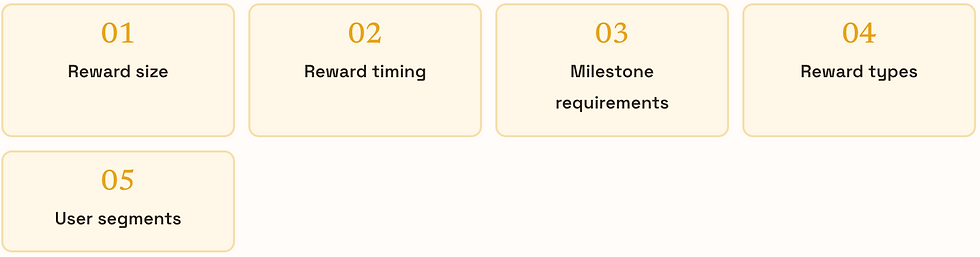
The best-performing rewarded UA programs treat reward design as an ongoing optimization process rather than a fixed campaign setting. What works for one geography, app category, or audience segment may not transfer directly to another — which is exactly why continuous testing matters.
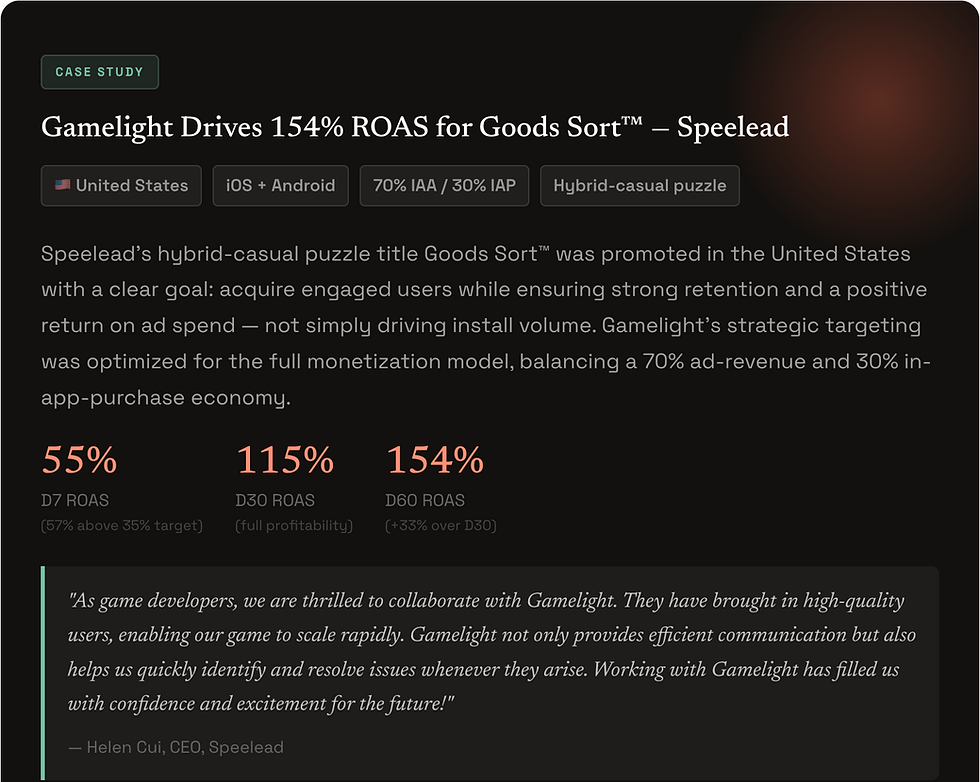
Case study: How Speelead's Goods Sort™ reached 154% ROAS with quality-first acquisition
Reward design principles are most convincing when paired with real outcomes. Here's what happens when a campaign is built around acquiring engaged users — not just installs.
-------------------------------------------------------------------------------------------------

The Goods Sort™ campaign is a clear illustration of the article's central argument: when reward structures are designed around genuine engagement rather than reward size alone, ROAS doesn't just hit a target and stop — it compounds.


Comments