
Gamelight Research: What Makes Rewarded UA Traffic High Quality?

The quality of mobile game traffic cannot be measured by install volume alone. Two campaigns may deliver a similar number of users at a similar acquisition cost, yet produce entirely different business outcomes over the following weeks and months.
This is particularly relevant for rewarded user acquisition. Because players receive an incentive for completing specific actions, publishers need to look beyond the initial campaign objective when evaluating whether the traffic is genuinely valuable. A completed milestone can demonstrate that a player was willing to engage with a game, but it does not automatically mean they will continue playing once the acquisition journey has ended.
For publishers, the real question is therefore not whether rewarded UA can generate engagement. It is what kind of engagement follows, how long it lasts, and whether it develops into meaningful value for the game.
A Campaign Completion Is Not the Same as a High-Quality User
Rewarded UA campaigns are built around defined milestones, such as reaching a certain level, completing a challenge, or spending a set amount of time in a game. Completing that milestone is useful, but it shouldn't be treated as the final proof of traffic quality.
The difference becomes clearer when looking at what happens next:
Campaign Completer | High-Quality Player | |
Completes the objective | ✓ | ✓ |
Returns after receiving the reward | Not necessarily | More likely |
Continues progressing | Not necessarily | ✓ |
Engages with more game features | Limited or unknown | ✓ |
Creates long-term value | Not guaranteed | Potentially |
Shows sustainable engagement | Not necessarily | ✓ |
The important distinction is that campaign completion measures whether the acquisition objective worked, while player quality measures whether the acquired user created value beyond that objective.
The Quality Journey
The player journey can be viewed as a progression from an externally motivated interaction toward increasingly organic engagement:
Rewarded campaign objective → Initial gameplay → Objective completed → Voluntary return → Deeper engagement → Long-term value
The first three stages can happen because of the acquisition incentive. The stages after that are where the game increasingly has to stand on its own.
This makes the transition from reward-driven behavior to product-driven behavior one of the most interesting things for publishers to measure.
A player who completes a milestone because there is a reward attached has demonstrated willingness to engage. A player who returns after receiving that reward has demonstrated something different: they have found enough value in the game to continue without the same immediate incentive.
That distinction can become increasingly important as publishers evaluate the long-term quality of their acquisition sources.
What Should Publishers Actually Measure?
Rather than relying on a single metric, publishers can evaluate rewarded UA traffic across several stages of the player journey.
A practical rewarded UA quality framework
Stage | Question to ask | Example indicators |
Acquisition | Did the user enter the game successfully? | Installs, campaign starts |
Completion | Did they reach the campaign objective? | Milestone completion |
Continuation | Did they stay after the reward? | Return rate, retention |
Engagement | Did their relationship with the game deepen? | Sessions, progression, feature usage |
Value | Did they contribute financially? | Ad revenue, IAPs, LTV, ROAS |
These stages help separate the initial success of a campaign from the longer-term quality of the users it delivers.
For example, a campaign can perform well at the acquisition and completion stages while producing weaker continuation. Another campaign may have fewer users complete the objective but generate stronger retention and higher downstream value.
The goal is therefore not to identify one universal definition of a "good" user. It is to understand how users move through the different stages and where value is ultimately created.
Quality Doesn't Always Reveal Itself Immediately
Traffic quality develops over the player lifecycle, which means timing matters when evaluating rewarded UA cohorts.
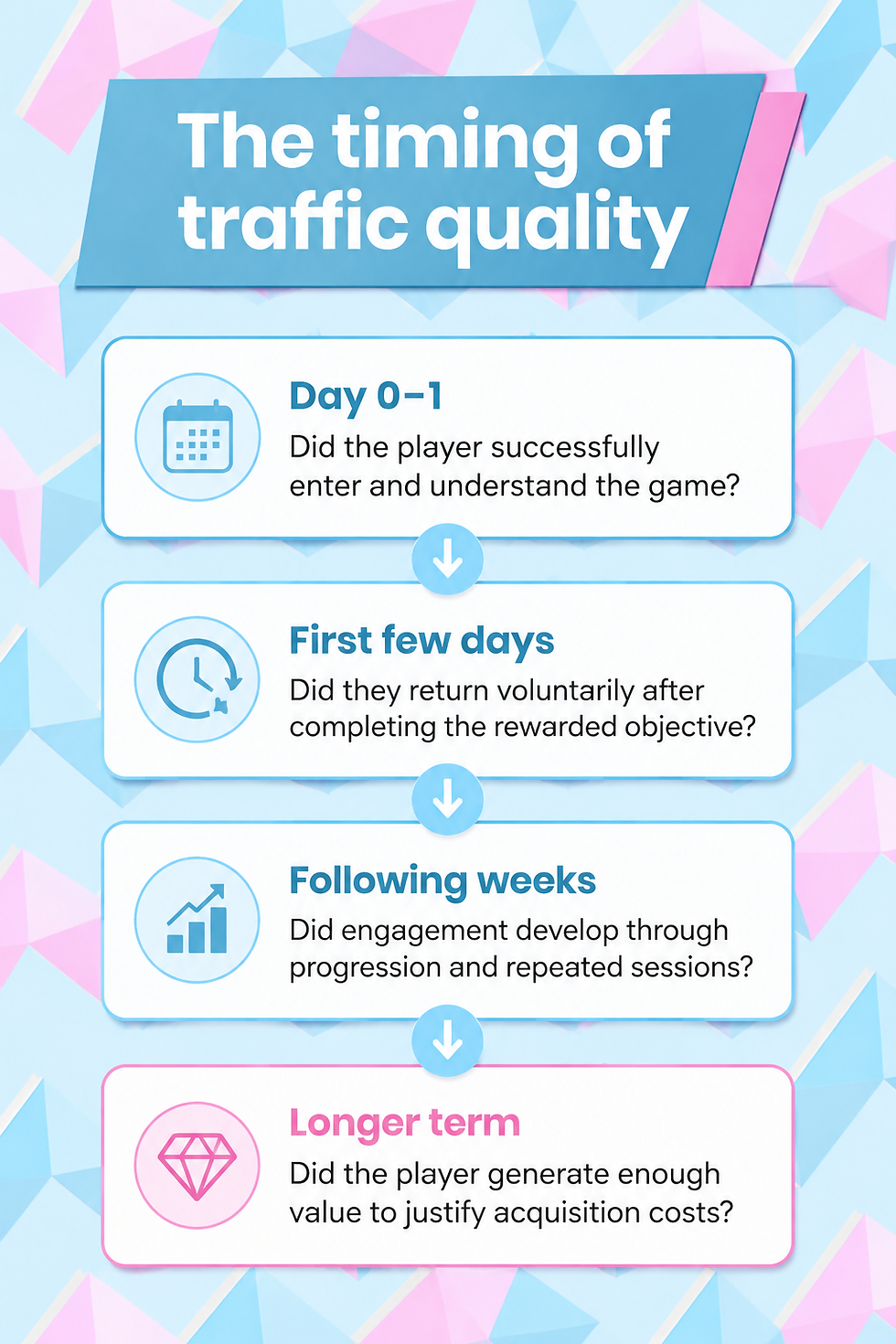
There is no single moment when a user suddenly becomes "high quality." Quality becomes clearer as more of the player lifecycle unfolds.
Early performance can show whether users are entering the game and completing the intended experience. Retention can then indicate whether they continue returning. Over a longer period, engagement and monetization data can reveal whether those players develop into a valuable audience.
This is why traffic quality is a pattern, not a one-time event.
The Campaign Objective Can Influence What Publishers Learn
The design of a rewarded UA campaign can also influence how much publishers learn about player quality.
An objective that requires very little interaction may be effective at generating volume, but it provides limited information about whether a player actually enjoys the game. A more meaningful progression milestone can give players enough time to experience the product before their subsequent behavior is evaluated.
That does not mean campaigns should simply require increasingly difficult objectives. If the requirement becomes frustrating or disconnected from the natural gameplay experience, it can create unnecessary friction.
A more useful approach is to select objectives that expose players to the game's core experience.
For example, reaching a level that introduces the main progression loop may be more informative than rewarding a player simply for opening the app. By the time they complete the objective, they have had an opportunity to experience the game and decide whether it is something they want to continue playing.
What Defines Quality
Günay Azer, founder of Gamelight, explains:

Rewarded UA Should Be Compared With Other Acquisition Sources
Rewarded UA traffic should not be evaluated in isolation. A retention rate or ROAS figure only becomes truly useful when publishers understand how it compares with their other acquisition channels. A source may deliver lower initial retention than another channel while still generating better economics because the users cost less to acquire. Similarly, a high-retention cohort may not be commercially attractive if acquisition costs are too high.
Comparing cohorts across different sources helps publishers understand where rewarded UA fits into their broader acquisition strategy.
It can reveal whether the channel reaches a different audience, performs particularly well in certain markets, or creates value at a different point in the player lifecycle.
The goal is not for every acquisition source to produce identical users. A healthy acquisition mix can include channels with different strengths, as long as publishers understand how those strengths contribute to overall growth.
Looking Ahead
The debate around rewarded UA traffic often focuses too heavily on the incentive itself. But the incentive is only the starting point of the relationship between the player and the game.
The more meaningful measure of quality is what happens once that initial reason to try the game has disappeared.
Does the player return voluntarily?
Does their engagement develop?
Does their behavior eventually create sustainable value?
Those questions give publishers a much more useful way to evaluate rewarded UA traffic quality than installs or campaign completion alone.
The strongest rewarded UA campaigns don't just bring players into a game. They create an opportunity for the right players to discover why they should stay.
Ready to Evaluate and Scale Your Rewarded UA?
For mobile app publishers looking to explore rewarded user acquisition, Gamelight provides a direct way to connect with high-intent users and build campaigns around meaningful in-app objectives.
Frequently Asked Questions
What is rewarded user acquisition?
Rewarded user acquisition is a mobile game acquisition model where players receive an incentive for completing specific actions within a game, such as reaching a level or completing a gameplay milestone.
Does completing a rewarded campaign mean the user is high quality?
Not necessarily. Campaign completion shows that a player was willing to engage with the game to reach a defined objective, but traffic quality is better evaluated by what happens afterwards, including retention, continued progression, engagement, and monetization.
How can publishers measure rewarded UA traffic quality?
Publishers can evaluate traffic across the full player journey, from acquisition and campaign completion through to continuation, engagement, and long-term value. Metrics such as retention, sessions, progression, ad revenue, IAPs, LTV, and ROAS can help provide a broader picture.
Why is post-reward behavior important?
Once the campaign incentive is no longer the reason to play, a player's behavior can provide a clearer indication of whether they have developed genuine interest in the game. Voluntary returns and continued engagement can signal a transition from reward-driven to product-driven behavior.
How long should publishers evaluate rewarded UA traffic?
There is no single timeframe that works for every game. Early data can show whether players enter and engage with the game, while longer-term retention, monetization, and LTV provide a clearer understanding of sustainable traffic quality.
Can rewarded UA deliver long-term players?
Yes. Rewarded UA can introduce players to a game through an initial incentive, but whether they become long-term players depends on the quality of the game experience and what happens after the campaign objective has been completed.


Comments