
What Is Rewarded User Acquisition?A Practical Guide for Growth Teams

Updated: Apr 17
Rewarded UA is not about cheap installs. It's a performance channel that bridges the gap between acquisition and activation — when done right.
User acquisition is the process of attracting new users to an app through marketing activity. In practice, growth teams judge acquisition quality not only by install volume, but by whether campaigns bring in the right users and generate meaningful downstream results.
Rewarded user acquisition applies that same performance mindset to a different kind of value exchange. Instead of relying only on standard paid placements, rewarded UA brings in users through campaigns where people receive a reward for taking a defined action — such as installing an app, completing onboarding, or reaching an in-app milestone.
That distinction matters. The best rewarded UA strategies are not really about buying cheap installs. They are about using incentives to create enough motivation for a user to start, engage, and reach the moments where your product's real value becomes clear. That is why rewarded UA should be evaluated as a growth channel — not as a volume trick.
What is rewarded user acquisition?
Rewarded user acquisition is a paid growth approach in which users are offered an incentive in exchange for completing an acquisition-related action. Depending on the setup, that action may be an install, a registration, a tutorial completion, or a deeper milestone inside the app. In the broader mobile marketing ecosystem, this is often discussed under labels such as rewarded UA, incentivized traffic, or opt-in value exchange advertising.
The key idea is simple: the user chooses to act because there is a clear benefit. That benefit might be in-app currency, points, cash-equivalent rewards, premium access, or another perk defined by the publisher or platform. From the advertiser's side, the goal is not just to trigger an install, but to move the user toward meaningful engagement.
Key Concept Rewarded UA sits at the intersection of acquisition and activation. It starts with a marketing incentive, but it only becomes valuable when the user continues beyond the initial conversion point. That is why strong rewarded UA programs are usually tied to post-install events rather than treated as install-only campaigns. |
How rewarded UA works
A typical rewarded UA flow starts with an offer. The user sees a clear incentive tied to a specific action: install an app, create an account, finish onboarding, reach a level, or complete another milestone. The important thing is that the expected action and the reward are both clear. This value-exchange structure is central to how incentivized traffic is described across the category.
From there, the user installs the app and begins moving through the funnel. But this is where rewarded UA becomes more interesting than a basic CPI campaign. A standard install campaign may optimize for cost-efficient downloads. Rewarded UA can go a step further by optimizing for users who continue into early product moments that actually predict value — such as registration, first purchase intent, tutorial completion, or early retention.
1 Offer exposure: User sees a clear incentive — install, sign up, complete a level — with an explicit reward attached. |
2 Install & onboarding: User downloads the app and begins the onboarding journey, motivated to reach the reward threshold. |
3 Milestone completion: The defined post-install action (registration, tutorial, first session) is completed and the reward is delivered. |
4 Post-reward retention: The true measure of campaign quality — does the user stay, engage, and generate downstream value? |
The better question for growth teams is not "How many installs did we buy?" but "What kind of user behavior did the campaign produce after install?" That is where rewarded UA either proves itself or fails.

Why growth teams use rewarded UA
The biggest reason is that many apps do not struggle with install volume alone. They struggle with early churn. Growth teams need channels that do more than generate a top-of-funnel spike; they need channels that help users reach a moment of relevance before they drop.
Incentivized traffic is often positioned as useful precisely because it can encourage users to stay long enough to experience deeper parts of the product, rather than bouncing immediately after install.
There is also a practical performance reason. Modern UA is increasingly judged by downstream efficiency, not vanity numbers. Once user acquisition becomes expensive, teams naturally move from "how cheap is this install?" to "what is the cost per valuable user?"


Rewarded UA can be especially attractive when a product has a clear activation moment that benefits from a little extra motivation. That is often true in gaming, but it can also apply to finance apps, utilities, and any product where value appears only after account creation, initial setup, or feature exploration.

Rewarded UA is not the same as "cheap installs"
One of the biggest misunderstandings around rewarded UA is that it is simply a shortcut to lower CPI. That is too narrow. Cheap installs that do not activate are not efficient. They are just cheap.
This is also why rewarded UA has a reputation gap. Some marketers associate incentivized traffic with low-quality users because they have seen campaigns optimized for the easiest possible conversion rather than for long-term value. But that is a campaign design problem, not a universal truth about the channel.
Think of it this way: incentives can help a user start the journey, but they cannot create product-market fit. If users reach onboarding or their first session and still find no value, the reward will not save the campaign. Rewarded UA can improve entry into the funnel. It cannot replace a strong product experience. |
The real question is whether incentives, targeting, and optimization are aligned with behavior that matters after install. When they are, rewarded UA becomes a serious performance channel. When they are not, it becomes a shallow volume play.

How to measure rewarded UA properly
If you evaluate rewarded UA only on installs, you will almost certainly misread the channel. The better approach is to look at a layered set of metrics.
At the top, you still need CPI and install volume. But below that, you should measure the actions that indicate real momentum — where CPA and in-app conversion metrics become more useful.
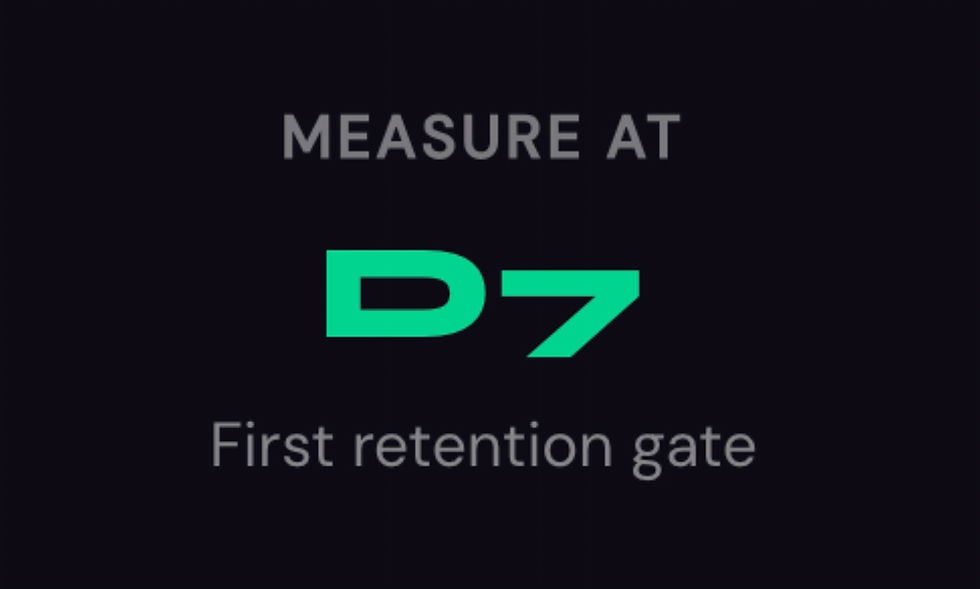
Retention should also be part of the picture early. Tracking retention across milestones such as Day 1, 3, 7, 14, 28, and 30 helps answer a simple question: did the campaign bring in users who stayed after the incentive did its job?
1 Install volume + CPI: The baseline. Still needed, but not the whole picture. |
2 Registration / onboarding completion: First real signal of intent beyond the download. |
3 Early in-app milestone: Tutorial completion, first session, first action — whatever unlocks your product's core value. |
4 D1 and D7 retention: The most critical short-term health check for any rewarded UA campaign. |
5 Downstream revenue / LTV: The ultimate arbiter of channel quality, once enough data accumulates. |
That kind of measurement stack keeps rewarded UA anchored to business outcomes instead of surface-level efficiency.

Common mistakes to avoid
1. Optimizing for install count alone
This pushes campaigns toward users who are easiest to convert, not users who are most likely to become valuable. If your only win condition is install volume, your campaign logic is too shallow for a channel that depends on post-install intent.
2. Offering an incentive disconnected from the product
When the reward is strong enough to get the click but has nothing to do with the product experience after install, you create curiosity but not commitment. The user completes the minimum step, collects the benefit, and leaves. The incentive should help users cross the gap to the app's real value — not distract from it.
3. Ignoring retention windows
A campaign can look successful on Day 0 and weak by Day 7. User quality is a time-based question. If rewarded UA is going to earn budget alongside other channels, it has to hold up after the first burst of incentivized engagement.
⚠ Common Trap Reward-chasing users — those who complete the minimum action just to claim the incentive — will inflate your install and CPA metrics while destroying your Day 7 retention. Always segment rewarded cohorts separately and track their long-term behavior before scaling spend. |
A note on compliance and channel design
Rewarded UA also needs to be understood in the context of platform rules. Google Play's policy is clear that developers must not manipulate app placement through illegitimate means — including incentivizing users to install other apps as the app's main functionality, or generating installs intended to manipulate store placement.
That does not mean every rewarded growth mechanic is the same thing. But it does mean growth teams should think carefully about how their acquisition channel is structured, what the core app experience is, and whether the product is compliant with store expectations.
Best Practice Rewarded UA should be treated as a performance and product design question, not just a media-buying trick. The reward motivates entry. The product must earn the relationship. |
Case study: MagicLab × Gamelight
Theory is useful. Results are better. Here's what rewarded UA looks like when a campaign is designed around long-term ROAS rather than cheap installs.

This outcome illustrates the core thesis: rewarded UA, designed correctly, doesn't just drive installs — it finds users whose engagement compounds over time. The channel exceeded D7 ROAS targets by 46% and D30 targets by 61%, with the campaign continuing to grow well beyond the initial measurement windows.
Final thoughts

Want to see rewarded UA in practice?
Explore our dashboard to see how rewarded user acquisition can be evaluated through the metrics that matter most — from installs and activation to post-install performance.
And if you would like to discuss your app, your goals, or whether rewarded UA is the right fit for your growth strategy, write to us. We’d love to hear more and help you explore the best approach.


Interesting read! It makes sense that giving users something worthwhile can help get them more engaged with a game. I also enjoy trying out simple games in my spare time, and minigame is a handy place to find free ones you can play right away. No downloads needed, which is always a plus.
An informative introduction to rewarded user acquisition and its role in attracting engaged users. Understanding incentives, campaign performance, and retention helps growth teams evaluate whether their marketing efforts deliver meaningful results rather than temporary activity. A https://grandoaksorthodontics.com/ clear strategy makes a difference in competitive markets, and the same attention to audience needs can benefit service-based organizations such as when building lasting customer relationships.
Excelente explicación sobre el potencial del Rewarded User Acquisition y su impacto en el crecimiento sostenible. lotería de hoy también refleja la importancia de analizar resultados estratégicamente. ¡Gracias por compartir un contenido tan útil e interesante!
Everything here feels easy to understand and the conversation flow is really friendly and smooth. A friend recommended this CPS Test for fast clicking and better click counter tracking online.
If you enjoy physics-based challenges, Drive Mad is worth a try. The learning curve feels natural, and each success actually feels earned.