
Is Rewarded TrafficHigh Quality?

The debate around rewarded traffic misses the point. Quality is not a channel label — it's the result of measurement. Here's what advertisers should actually track.
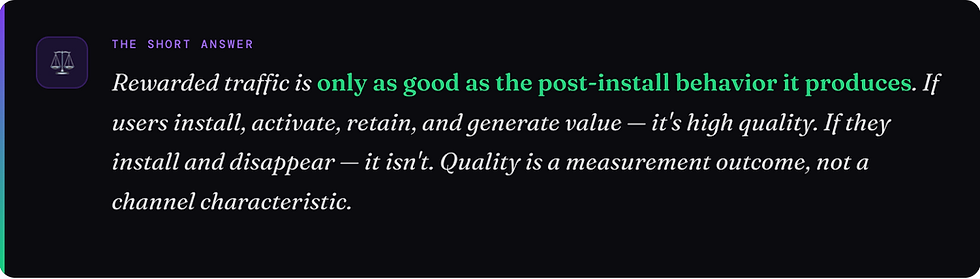
Rewarded traffic is one of the most debated channels in mobile user acquisition. Some advertisers see it as a high-intent, performance-driven channel built on a clear value exchange. Others worry that incentives may drive low-quality installs that disappear as soon as the reward is delivered.
The truth is more nuanced — and more useful. Rewarded traffic is not automatically high quality or low quality. Its quality depends entirely on what behavior it produces after the conversion. Advertisers who evaluate the channel only on install volume will almost certainly misread it. Advertisers who measure what actually happens after install will get a much more accurate answer.
This guide walks through the five metrics that make that answer possible.

Why rewarded traffic gets questioned in the first place
The skepticism is easy to understand. In rewarded traffic, a user takes action because there is an incentive — a reward is promised, and the marketer defines the action required to earn it. That setup naturally raises a concern: are users acting because they care about the app, or only because they want the reward?
That concern is valid, but incomplete. Traditional paid traffic is not "pure intent" either — every acquisition channel contains some mix of curiosity, convenience, persuasion, and timing. Rewarded traffic simply makes one part of that motivation visible. The more important question is whether the incentive helps users cross an initial friction point and then continue into real product value.
The reframe that matters: the fact that a reward triggered the install is not the deciding factor. The deciding factor is whether the campaign brings in users who continue to matter after the reward has done its job. That determination can only come from post-install measurement — not from the channel's mechanics alone. |
The biggest mistake: treating installs as proof of quality
The easiest way to overestimate rewarded traffic is to stop at installs. CPI is useful — it tells you what it cost to acquire the install — but it does not tell you whether that install led to registration, activation, retention, revenue, or any meaningful business outcome.
This is why install-heavy reporting creates false confidence. A channel can look efficient on CPI and still perform poorly if users churn immediately after first open. By contrast, a campaign with a slightly higher install cost can be the better investment if it produces stronger activation and downstream revenue.
⚠ Common Trap A channel that looks "cheap" on CPI is only cheap at the wrong stage of the funnel. Low CPI paired with weak activation is not efficiency — it is wasted spend at a discount. Real efficiency connects acquisition cost to the value created after install. |

The 5 metrics that actually answer the quality question
01 CPI — but only as an entry signal
Advertisers should still track CPI because it shows how efficiently a channel is producing attributed installs. It is a useful top-of-funnel budgeting signal. But it should be treated as the beginning of the analysis, not the conclusion.
A simple way to think about it: CPI answers "How much did the install cost?" It does not answer "Was the user worth acquiring?" That second question needs deeper metrics. Once you understand that framing, CPI becomes a useful early filter rather than a final judgment.
02 Activation and early in-app events
The first layer beyond CPI should be activation. Depending on your app, that means registration, onboarding completion, tutorial completion, account verification, first session depth, or another milestone that signals the user actually entered the product journey.
This is where rewarded traffic begins to separate strong from weak. A channel that drives installs but weak activation is buying curiosity, not momentum. A channel that drives installs and healthy early-event completion is much closer to bringing in real users.
Key Implication Rewarded traffic can be structured around deeper required actions — not just the install. Requiring a user to reach a level, complete onboarding, or register before the reward is delivered shifts the quality bar upward from the start. CPA at a meaningful activation event is a more honest signal than CPI alone. |
03 Retention — especially D1 and D7
If activation tells you whether users started, retention tells you whether they stayed. Retention should be checked at specific milestones — Day 1, 3, 7, 14, 28, and 30 — because that cadence helps separate short-lived reward behavior from real user continuation.
For rewarded campaigns, D1 and D7 are especially revealing. If D1 is strong but D7 collapses, the campaign is generating initial activity without producing durable value. The incentive may have created conversion without creating engagement.

These benchmarks are a useful reminder that quality must be judged over time, not at the moment of install. A rewarded cohort that tracks close to or above these numbers is performing well. A cohort that falls sharply below them — especially at D7 — is a signal to investigate the incentive-to-onboarding connection.

04 LTV and ROAS — the economic verdict
Eventually, traffic quality has to connect to economics. LTV measures the revenue a business can expect from a user or cohort over their relationship with the app. ROAS measures the revenue earned relative to ad spend. Taken together, these metrics answer the question that really matters: did the users acquired through rewarded traffic create enough value to justify the budget?
This is where many channel comparisons become more honest. A campaign with very attractive CPI may still lose if its LTV is weak. A campaign with a higher CPI may still win if it produces better downstream revenue and healthier ROAS over D7, D30, and beyond.
The cohort test: compare rewarded traffic cohorts against other paid channels on activation, D1/D7 retention, event completion, LTV, and ROAS. That is the only comparison that tells you whether the channel is earning its budget — and it often reveals that rewarded UA outperforms on long-term value even when it looks more expensive upfront. |

05 Attribution hygiene and fraud sanity checks
There is one more layer advertisers should not ignore: data integrity. If rewarded traffic looks unusually efficient, that does not always mean the users are especially strong. It can also mean measurement is being distorted.
CTIT — click-to-install time — is a critical metric for identifying click injection and click spamming, both of which can skew attribution and make poor traffic appear more valuable than it is. Click spam involves fraudulent click activity designed to claim credit for installs the campaign did not truly influence.
⚠ Fraud Signal Watch for suspicious CTIT patterns, installs that are high but meaningful post-install events are abnormally weak, and attribution behavior that breaks from expected funnel logic. If measurement is corrupted, even strong-looking performance dashboards can tell the wrong story. Rewarded UA should be held to the same attribution discipline as any other paid channel. |
What a practical rewarded UA scorecard looks like
Most teams do not need dozens of metrics. They need the right sequence of metrics, measured in layers. Here is what a strong rewarded UA evaluation stack looks like in practice:

The key is not to measure everything at once, but to measure in layers. Start with top-of-funnel efficiency, validate activation, test retention, evaluate monetization, and verify data integrity. That way, rewarded UA is assessed as a full-funnel channel — not a CPI line item.
Case study: AZUR Games × Gamelight — rewarded UA delivering on every metric layer
Abstract measurement frameworks are useful. Real results are better. Here is what it looks like when a rewarded UA campaign is evaluated across the full scorecard above — not just on install cost.

The AZUR Games results demonstrate the core argument of this article: rewarded traffic quality is not something you assess before running a campaign. It is something you measure throughout. When the right events are tracked and the right metrics are applied at each layer of the funnel, rewarded UA produces results that speak for themselves.
Final thoughts: quality is a measurement outcome
Advertisers asking whether rewarded traffic is "high quality" are usually asking the right question in the wrong way. Quality is not a label you attach to a channel in advance. It is the result of what you measure — and when you measure it.
Rewarded traffic should be judged by the same standards that define strong acquisition everywhere: efficient acquisition, meaningful activation, healthy retention, reliable attribution, and economic return over time. If advertisers measure only installs, they will get a shallow answer. If they measure what happens after install, they will get a useful one.
And for rewarded traffic, that difference is everything. Explore the Gamelight dashboard to see how rewarded UA is measured across the full funnel, or reach out at partners@gamelight.io to discuss your app's goals directly.


Great insights on moving beyond the "rewarded traffic = low quality" myth. You're absolutely right—quality emerges from behavior, not channel labels. Tracking D1/D7 retention and ROAS is key, and having reliable data visualizations helps teams spot trends faster. For teams building internal reports, I’ve found ChartsPrintables useful for quickly generating clean, printable metric and conversion charts to share with stakeholders.
Your work is very good and I appreciate you and hopping for some more informative posts.
scalable data centers
Really good explanation here, and the article keeps things simple for readers. I had a chance to try Geometry Dash Lite unblocked and enjoyed the rhythm-style levels, obstacle patterns, and smooth gameplay. It’s a fun way to spend a few minutes with an engaging arcade challenge.
I like how Cool Games gives me something enjoyable to do while taking a break from bigger projects. It feels rewarding without taking much time.